

Why Is My AC Freezing Up in the Texas Heat?
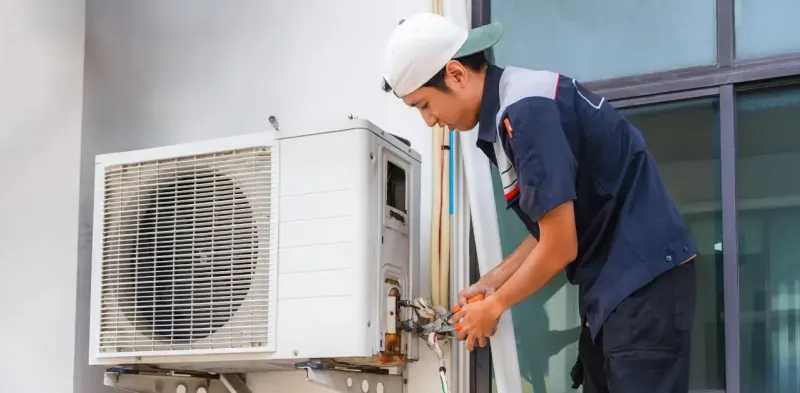
Ice forming on an air conditioner during a Texas July looks like a contradiction, but the cause has nothing to do with the weather outside your window. Your system freezes because the evaporator coil inside the indoor air handler has dropped below 32°F, and that happens when airflow across the coil is restricted or when the refrigerant charge has fallen below where it should be.
Those two conditions account for the overwhelming majority of freeze-ups, and the airflow half of that split is often something a homeowner can resolve in ten minutes.
Before you read any further, switch the thermostat from Cool to Off while leaving the fan set to On, because continuing to run a frozen system is what turns an inexpensive problem into a compressor replacement.
What Ice on Your AC Unit Is Telling You
An air conditioner cools your house by passing warm indoor air across a coil filled with cold refrigerant, and that warm air is the only thing keeping the coil above freezing while the system runs. When something interrupts that flow of warm air, the coil temperature keeps dropping past the point where the moisture condensing on its surface turns to frost rather than draining away as water.
Once a thin layer of frost forms, the problem accelerates on its own, because ice acts as an insulator blocking even more heat from reaching the refrigerant inside. A light dusting on a few fins can become a solid block encasing the whole coil within hours, which is why systems that seemed fine in the morning are blowing warm air by mid-afternoon.
Most freeze-ups begin at the indoor evaporator coil hidden inside the air handler in your attic or utility closet, so the first visible evidence is usually frost creeping along the insulated copper suction line where it exits the unit. Lennox notes that ice on the coils signals either an airflow restriction or a low refrigerant charge, which is the same diagnostic fork every technician works from.
AC Freezing Up in a DFW Summer: Airflow or Refrigerant?
Peak summer makes freeze-ups more likely rather than less, because a system running fourteen hours a day through a stretch of 100°F afternoons never gets the idle time it would otherwise use to shed accumulated frost. A unit that coped through a mild June can start icing over in late July on exactly the same charge and exactly the same filter, simply because the run time has doubled and the humidity load on the coil has climbed with it.
Sorting airflow problems from refrigerant problems is the whole diagnostic exercise, and the clues below will usually tell you which side you are on before a technician ever arrives.
| What you observe | Points to an airflow problem | Points to low refrigerant |
| Where ice appears first | Indoor coil and the plenum around it | Outdoor suction line and service valve |
| Filter condition | Visibly grey or matted with dust | Clean and recently changed |
| Airflow at the supply vents | Already weak before any ice formed | Normal until the ice built up |
| Behaviour after a full thaw | Fixed by a new filter and stays fixed | Freezes again within a day or two |
| Sound near the indoor coil | Nothing unusual | A faint hiss or bubbling |
Two local factors sit underneath both columns. Attic-mounted air handlers, which are common across DFW housing stock, sit in attic temperatures that climb far above the outdoor reading through August, so any duct leak pulling that superheated air into the return side changes coil conditions dramatically.
Filter loading is the other, because a system entering peak season on a filter that has been in place since spring is already restricted before the hardest run hours begin.
What Happens If You Run Your AC While It Is Frozen
Running a frozen air conditioner risks the most expensive component in the system, because liquid refrigerant that should have evaporated inside the coil travels back down the suction line and reaches the compressor instead. Compressors are built to handle vapour rather than liquid, and the resulting damage, known in the trade as slugging, can destroy the unit in a single extended run.
Carrier is direct on the point, stating that a frozen air conditioner will not fix itself and requires intervention to prevent permanent failure. Waiting for the ice to clear while the system keeps running is the worst available option, because the compressor is under load the entire time the coil stays blocked.
The secondary risk is water. All of that ice eventually melts, and a volume of meltwater far beyond what the drain pan was designed to handle can overflow into the ceiling below an attic air handler. Cold Factor covers the drainage side of this in a separate guide on preventing water damage in Texas homes, and a freeze-up is one of the fastest ways to discover that your condensate line was already partially clogged.
How to Thaw a Frozen AC Line Safely
Set the thermostat mode to Off and the fan to On, which pushes room-temperature air across the coil and melts the ice considerably faster than simply shutting the whole system down. Carrier puts a typical thaw at one to four hours depending on how much ice has accumulated, and the system needs to be dry before it runs in cooling again rather than merely looking clear at the visible edges.
Never chip or scrape at the ice, because the aluminium fins on an evaporator coil bend under almost no pressure and a punctured coil turns a filter problem into a sealed-system repair. Heat sources cause a different kind of damage, since a hair dryer or space heater aimed at a frozen coil risks thermal shock severe enough to crack components outright. Patience costs nothing here, while an hour saved with a screwdriver can cost a coil replacement.
While the system thaws, work through the airflow side so that the same freeze does not simply repeat once you restart:
- Replace the air filter rather than inspecting it and putting the old one back
- Open every supply register in the house, including the ones in rooms nobody uses
- Pull furniture and stored boxes away from any return grille
Filters in DFW homes generally need replacing every 30 to 60 days through summer rather than the quarterly schedule most packaging suggests, and Cold Factor has written previously on how filters affect overall efficiency beyond just freeze-ups.
The three minute rule for AC becomes relevant when you restart. Modern systems include a built-in delay of roughly three to five minutes before the compressor re-engages, which protects it from starting against high head pressure, so a unit that appears to do nothing immediately after you switch back to Cool is usually behaving exactly as designed.
How to Tell If Your AC Is Low on Refrigerant
Refrigerant is not consumed the way fuel is consumed, and it circulates in a sealed loop that should never need topping up across the life of a properly installed system. A low charge therefore means a leak somewhere in that loop, which is why simply adding refrigerant without finding the leak amounts to paying for the same repair again the following summer.
The clearest sign is a system that freezes again within a day or two of a complete thaw and a fresh filter, since you have already eliminated the airflow explanation by then. A few other symptoms tend to show up alongside it:
- A faint hissing or bubbling audible near the indoor coil while the system runs
- An oily residue around fittings or brazed joints on the refrigerant lines, left behind because escaping refrigerant carries compressor oil with it
- Cooling that has degraded gradually across the season rather than failing all at once, which is the signature of a slow leak
You can also read it in the performance. A properly charged system should generally deliver air at the supply vents somewhere between 15 and 20°F cooler than the air entering the return grille, and a gap much narrower than that on a system with clean airflow points toward charge. Diagnosing this properly requires manifold gauges on the service ports, which is licensed work rather than a homeowner check.
Is My AC Broken If It Freezes?
A freeze-up is a symptom rather than a diagnosis, and the underlying cause ranges from a filter you can replace yourself in five minutes to a compressor at the end of its service life. A single freeze that resolves after a thaw and a new filter, and then never returns that season, generally means the system is fundamentally sound and was simply starved of airflow.
Repeat freezing tells a different story. A system that ices over again after you have corrected the obvious airflow problems has something wrong inside it, and the cause usually sits in one of three places:
- A refrigerant leak somewhere in the sealed loop
- A failing blower motor that no longer moves the airflow the system was designed around
- An evaporator coil so fouled with grime that no filter change will restore heat transfer across it
Age shifts the odds. On a system past twelve years, particularly one still running R-22, chasing and recharging a leak often costs more than the remaining life of the unit justifies.
Book a Cold Factor AC Repair Visit
When your system has thawed and taken a fresh filter but frozen again anyway, the problem sits inside the sealed system where homeowner checks cannot reach. Cold Factor works out of Roanoke and Flower Mound, serving Lewisville, Coppell and the surrounding DFW area.
A frozen system in the middle of an August heat wave is worth treating as urgent rather than something to watch for a few more days, and Cold Factor offers emergency service alongside standard HVAC repair and maintenance scheduling. Check our current specials before you book.